The problem: a scaler is a system, not a box
A new scaler arrives, the first tip bought for it will not screw on, the spare handpiece has the wrong connector, and the daily tips have been worn past their useful length for months. Unit, handpiece, tips and wrench form one system, and most buying mistakes are mismatches inside it. This guide explains how ultrasonic scalers work, how to match tips and handpieces, how to manage aerosol and patients with cardiac devices, and how the items we stock fit together.
Understand: how an ultrasonic scaler works
Piezoelectric and magnetostrictive
Both types turn electrical energy into vibration of a metal tip at ultrasonic frequencies; the tip breaks calculus away while a water spray cools it and flushes debris. In a piezoelectric unit, elements in the handpiece expand and contract in an alternating electrical field; the tip moves mainly in a line, at about 25 to 50 kHz, and works with its lateral surfaces, much as a hand instrument does.1 In a magnetostrictive unit, a metal stack in a removable insert responds to a magnetic field, and the tip follows an elliptical path with all sides active.1 Piezoelectric handpieces generate little heat but still need irrigation for cooling and lavage.1 A magnetostrictive stack warms in use and needs a steady water flow.
Ultrasonic or hand instruments
The European Federation of Periodontology's S3 guideline recommends subgingival instrumentation with hand or powered instruments, alone or combined; outcomes did not depend on the instrument type.2 A scaler is bought for the way the clinic works, not for a better healing result.
Frequency: 25K and 30K inserts
Frequency is fixed by the system and matters mainly for magnetostrictive inserts, made for 25 kHz or 30 kHz units and labelled 25K or 30K. The 30K inserts are shorter; most automatically tuned units take only 30K, and a few accept either.3 Check the manual before ordering.
Tips by task
Piezoelectric tips are coded by task; our product names follow the Woodpecker and EMS convention:
- G, supragingival. G1 for deposits, G2 for heavy deposits, G3 and G4 for interproximal areas, G5 for gross scaling.
- P, periodontal. Slimmer tips for root surfaces and pockets, such as P1 and the pointed P4; Sirona's PS1 and PS4 do this on Sirona handpieces.
- E, endodontic. E12D and the E15 broken-file remover, used at low power under magnification.
- Restorative. Most systems also make tips for jobs such as cement removal. Codes differ between systems, so check the maker's tip chart.
Tip wear
Tips shorten with use. A 2 mm loss of length is estimated to halve scaling efficiency, the usual point to replace a tip or insert.3 A worn tip invites harder pressure, which the patient feels. Check tips against the manufacturer's wear card or a new tip, and keep spares of the ones used daily.
Threads, connections and the torque wrench
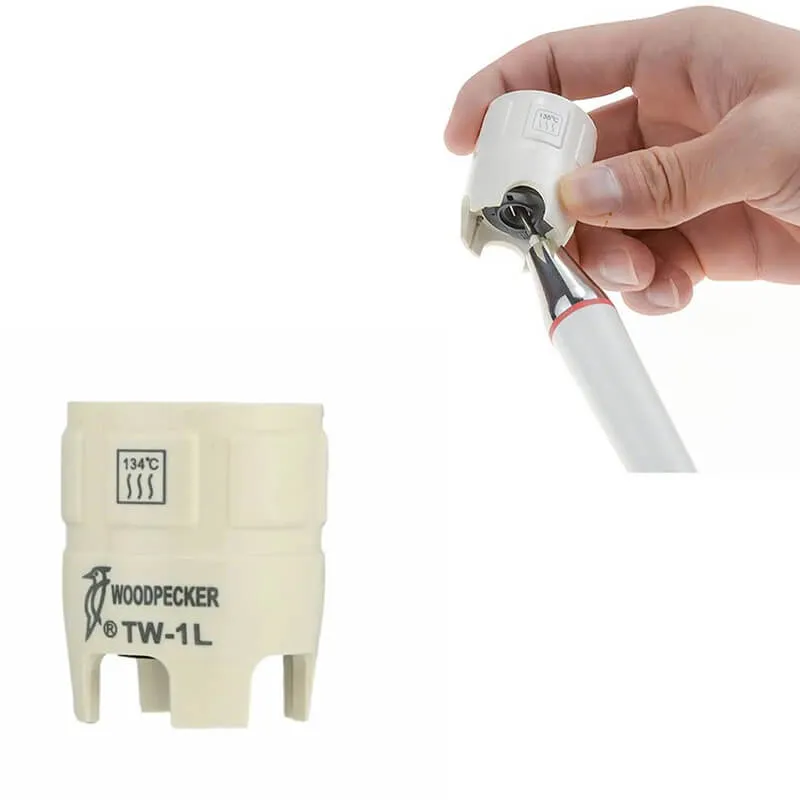
Piezoelectric tips screw onto the handpiece, and threads differ: EMS-thread tips fit EMS and compatible handpieces, and S-threaded tips fit Satelec and compatible handpieces.3 Our product names show the families we stock: Woodpecker with EMS, DTE with NSK and Acteon (the company behind Satelec), Sirona with Sirona. The handpiece must match the unit, so order a replacement by the model code on the old one. Tighten tips with the system's torque wrench, never pliers: a loose tip vibrates poorly, an over-tightened one strains the thread, and a torque-limiting wrench stops at the correct tightness.3
Water, power and light
A built-in or mains-connected unit uses the chair's or a tap's water, so it is only as clean as that line. A unit with an external bottle can run distilled or sterile water, or an irrigant its instructions allow, and moves between rooms. Set power within each tip's printed range; periodontal and endodontic tips run lower than heavy supragingival tips. An LED handpiece lights the field but needs a unit that powers the light.
Aerosol
A systematic review found a significant increase in airborne bacteria with ultrasonic scaling, reaching up to 2 m from the mouth, and no significant difference between high-volume and low-volume suction; the authors recommend suction throughout, suitable masks and at least 30 minutes between appointments.4
Patients with cardiac implantable electronic devices
Laboratory tests have shown interference between magnetostrictive scalers and pacemakers or implantable defibrillators, though laboratory set-ups do not reproduce clinical conditions. Clinical studies found no interference between piezoelectric scalers and defibrillators and no adverse effect on pacemakers, and the American Dental Association describes piezoelectric scalers as safer. At 15 cm or more interference is not considered likely; the ADA advises consulting the patient's cardiologist and keeping cords off the chest.5 Read the unit's own instructions too.
Options: what we stock
| Item | Type | Features (name or manufacturer) | Fits |
|---|
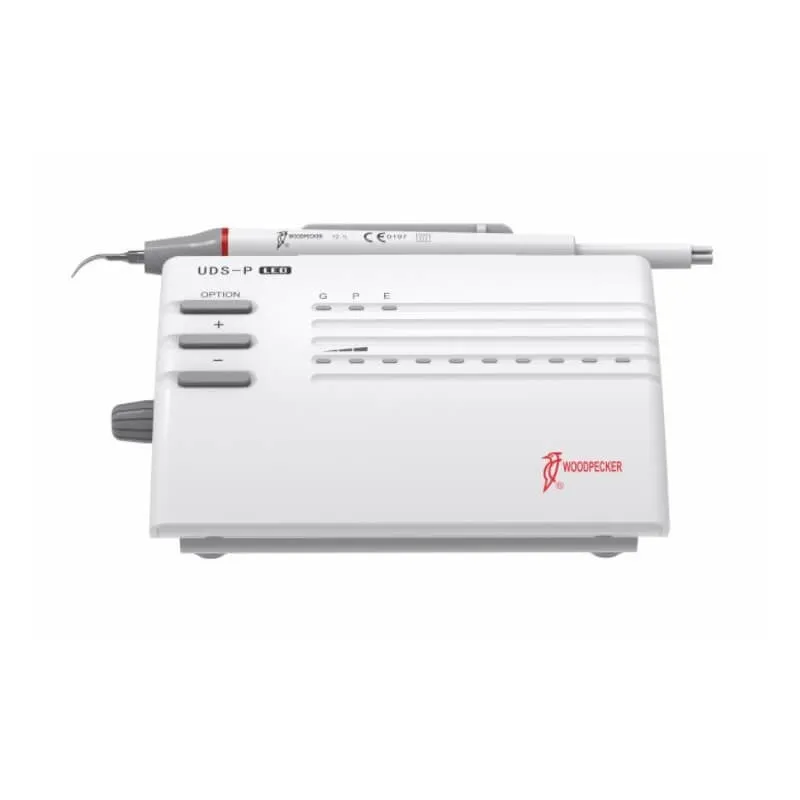
| UDS-P LED, UDS-E LED | Piezoelectric unit (Woodpecker) | LED handpiece | Woodpecker and EMS-thread tips |
| EMS Mini Piezon | Piezoelectric unit (EMS) | Supplied with handpiece | EMS-thread tips |
| DTE-D5 LED | Piezoelectric unit (DTE) | LED handpiece | DTE, NSK and Acteon tips |
| U6 LED; Cleanse S Scaler Set | Scaler units | LED on the U6; Cleanse S handpiece stocked | Check the tip family on the listing |
| LED Ultrasonic Dental Scaler built-In | Chair-mounted | LED; chair water | Chairs with a free instrument position |
| Ultrasonic Scaler with External Bottle | Standalone unit | Own water bottle | Sterile water, irrigants, rooms without water |
| Sirona handpiece, SiroSonic L (for Intego), PS1 and PS4 tips | Sirona handpieces and tips | PS1 for subgingival deposits; PS4 for shallow pockets | Sirona chairs |
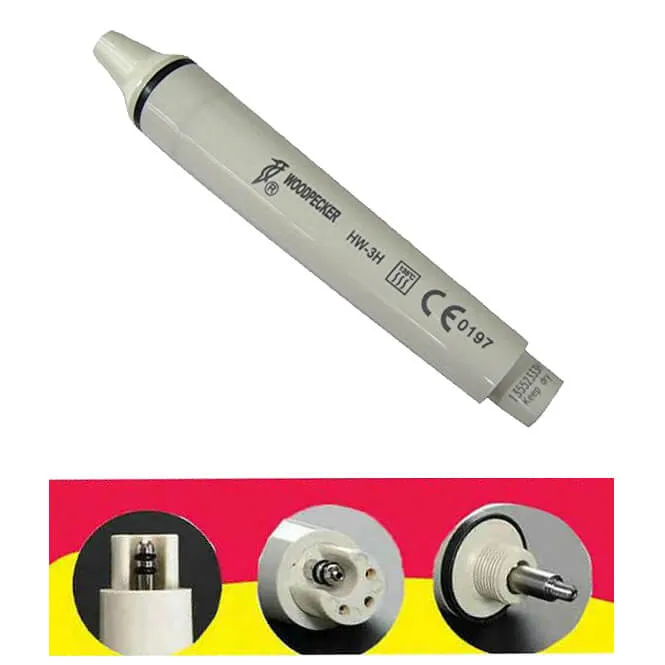
| HW-3H, HW-5L (with LED), HD-7H, HD-8H, HD-8L, 3H, DTE handpiece with LED | Replacement handpieces | LED on the HW-5L and the DTE handpiece | The unit with the matching model code |
| Woodpecker G1 to G5 and P4; G and P tip sets | Scaling and periodontal tips | Sets marked Woodpecker, Demtec and EMS, or Woodpecker and EMS only | Woodpecker and EMS-thread handpieces |
| GD1 (two), GD2, GD4, PD1 set | Scaling and periodontal tips | Five tips | NSK, DTE and Acteon handpieces only |
| E12D; E15 broken-file remover | Endodontic tips | E15 loosens separated files | Confirm the thread on the listing |
| INFINITIP #10 and #100 (25K); Cavitron Powerline FSI 10 (30K) | Magnetostrictive inserts | 25K and 30K | Cavitron-type units of that frequency |
| INFINITIP tips with key for EMS PS and Satelec 10P | Piezoelectric tips | Key included | EMS or Satelec handpieces |
| Woodpecker Torque Wrench | Tool | For fitting tips | Woodpecker tips |
With a unit, buy its daily tips in the same thread, the torque wrench and a spare handpiece.
Compare: piezoelectric or magnetostrictive
| Criterion | Piezoelectric | Magnetostrictive |
|---|
| Tip motion | Mainly linear; lateral surfaces | Elliptical; all sides |
| Frequency | About 25 to 50 kHz | 25K or 30K inserts |
| Heat and water | Little heat; water still needed | Stack warms; steady water needed |
| Working part | Tip screwed on with a wrench | Insert with stack and O-ring |
| Sterilisation | Heat-sterilise handpiece and tips between patients | Steam; dry heat damages O-rings |
| Cardiac devices | No interference in clinical studies | Interference in laboratory tests |
| Clinical outcome | Comparable to hand instruments | Comparable to hand instruments |
| Aerosol | Raises airborne bacteria | The same |
Choose a piezoelectric unit for a new room: it runs cooler, is regarded as safer for patients with cardiac devices, and our branded units (Woodpecker UDS, EMS Mini Piezon, DTE-D5) are all piezoelectric. Choose magnetostrictive inserts if you already own a Cavitron-type unit. Choose a bottle unit for sterile water, irrigants or moving between rooms, and a built-in unit for a chair with a free position and a maintained waterline.
Using an ultrasonic scaler well
- Match first. Tip thread to handpiece, handpiece to unit, and 25K or 30K for magnetostrictive inserts.3
- Use the wrench. Fit and remove tips with the system's torque wrench, never pliers.3
- Water first. See the spray reach the tip before touching the tooth, never scale dry, flush the handpiece line before each patient as the instructions direct, and use sterile water or sterile saline from a bottle for surgical work.
- Power for the tip. Stay within the tip's range, keep it moving with light pressure, and place a piezoelectric tip's lateral surface, not its point, on the tooth.1
- Control aerosol. Suction throughout, masks and eye protection for team and patient, and time between appointments.4
- Ask about cardiac devices. Record them, consult the cardiologist, keep the handpiece and cable away from the device and off the chest, and prefer a piezoelectric unit.5
- Reprocess between patients. Clean, then heat-sterilise the handpiece and tips following the manufacturer's instructions; surface disinfection is not enough for handpieces.6 Steam-sterilise magnetostrictive inserts, because dry heat damages their O-rings.3
- Check wear weekly. Compare tips with the wear card or a new tip, and replace any that has lost 2 mm.3
Recommended products
Three piezoelectric units to compare, and one that runs from its own bottle: