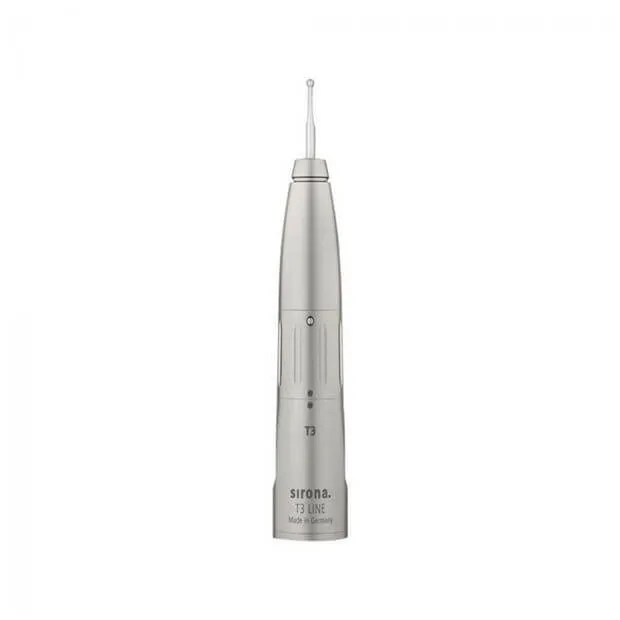
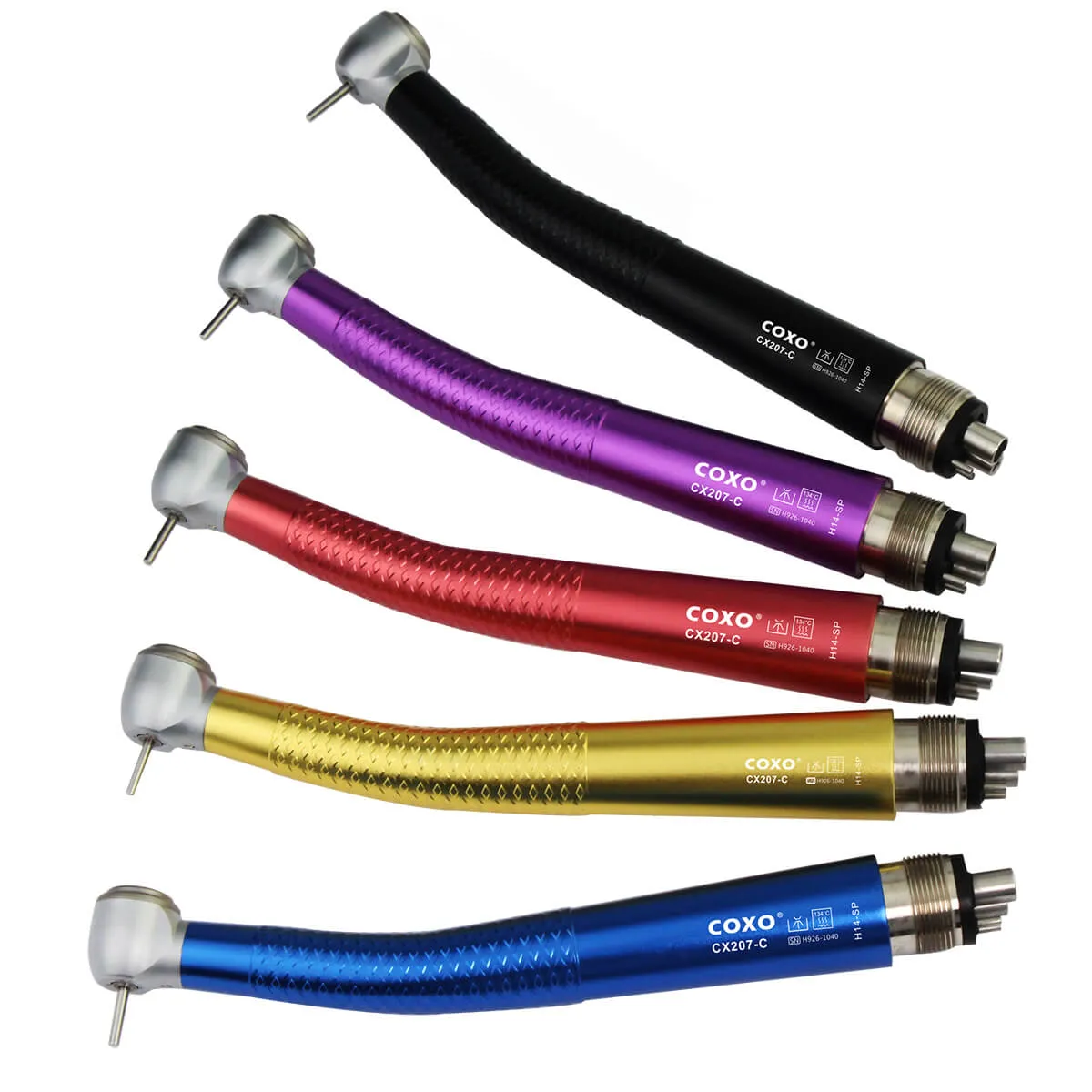
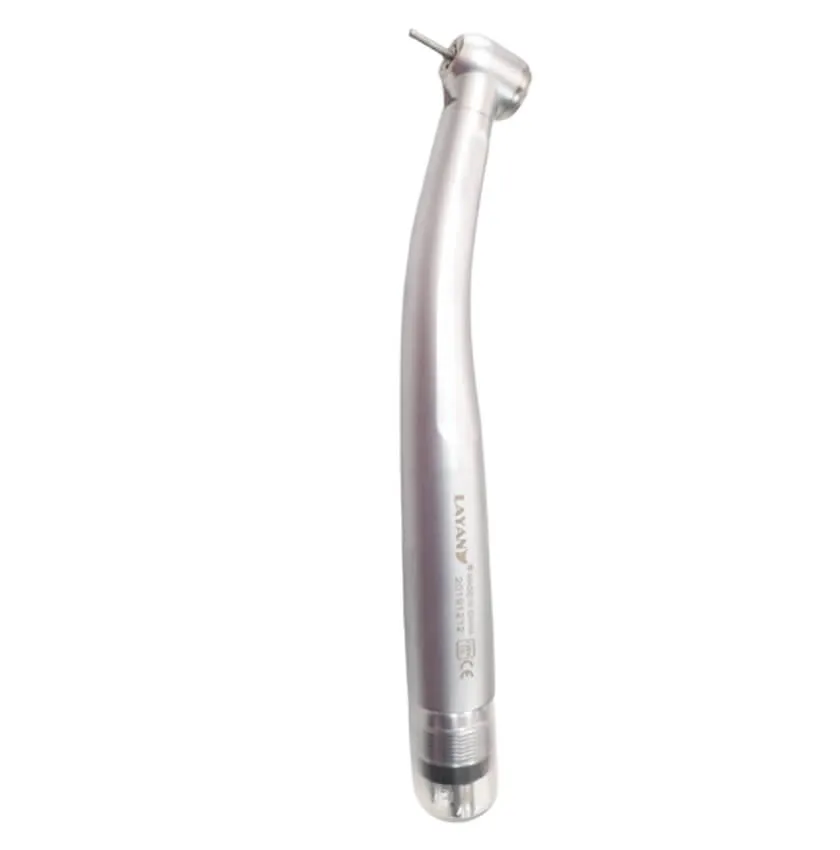
The problem: a handpiece bought on its speed rating
A new turbine arrives with a headline speed on the box. It will not fit the chair's Borden hose; once adapted, it stalls on an old metal-ceramic crown; and when it is used to section a lower third molar under a flap, the patient's cheek swells with air. None of these is a manufacturing fault. Each is a buying decision made on the wrong specification. This guide covers drive type, high and low speed, surgical handpieces, connections and bearing care.
Understand: how a high-speed handpiece cuts
Air turbine: free-running speed is not cutting speed
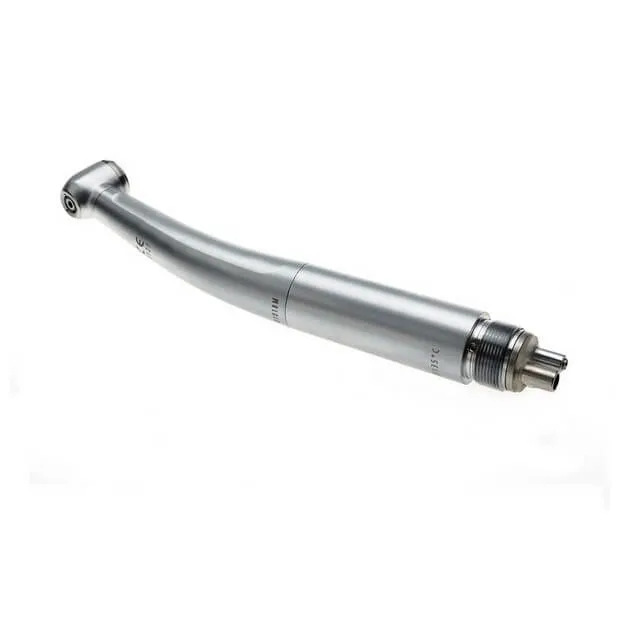
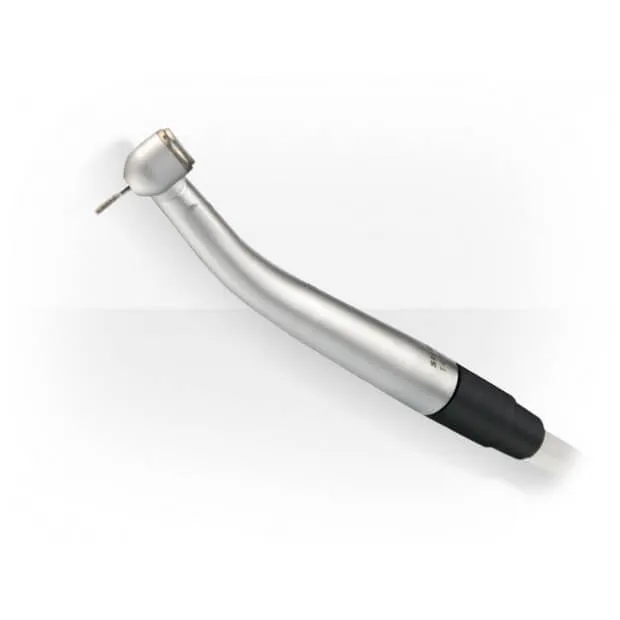
An air turbine is a rotor in the head spun by compressed air. Its quoted speed is the free-running speed, with nothing touching the bur; under load the rotor slows and delivers more torque, and pressed harder it stalls. Compare power at working speed instead: Dentsply Sirona states up to 30 W for the T3 Racer and 21 W for a T3 mini.1 Turbines are light and relatively inexpensive, and a worn cartridge (rotor and bearings) can be replaced.
Electric 1:5 contra-angle: speed held under load
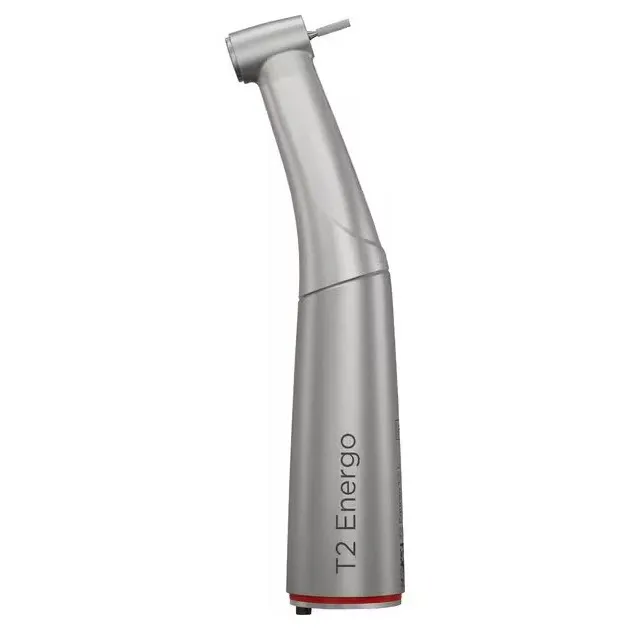
An electric micromotor drives the bur through gears. A 1:5 red-ring contra-angle, the "high speed contra", turns the bur five times faster than the motor, so 40,000 rpm at the motor gives 200,000 rpm at the bur, and the control unit holds that speed as load rises, up to its torque limit. In a laboratory comparison across seven materials, an electric handpiece cut more efficiently than an air turbine.2 The costs are the micromotor and control unit, more weight in the hand, and gears that need lubrication.
Head size, spray and light
A standard head suits most restorative and crown work, and a torque head has a larger rotor for crowns and metal. A mini head helps in children, third molars and limited opening; the T3 mini head is 12.7 mm tall and 10.2 mm across.1 A single spray port cools one side of the bur, while three- and four-port sprays surround it. Fibre-optic light comes from a lamp in the coupling and needs an optic hose; an LED with a built-in generator lights up on a plain 4-hole hose.
Bearings, chuck and anti-retraction
The rotor runs on miniature ball bearings, ceramic in the T3 range.1 A rougher sound, vibration, bur wobble and loss of speed mean they are worn. Never press a push-button chuck while the bur turns. When a handpiece stops, oral fluid can be drawn back into the head and waterlines; anti-retraction valves are meant to prevent it, yet in a study of 58 dental chair units, 30 failed a retraction test, and bacterial counts in the water rose with the volume retracted.3 Dentsply Sirona fits T3 turbines with a protective head system to lower the risk of cross-contamination.1
High speed vs low speed handpiece: what each is for
High-speed handpieces, the turbine and the 1:5 contra-angle, take friction-grip burs and cut enamel, dentine, restorations and crowns with water spray. Low-speed handpieces run slower with more control on a micromotor or air motor: caries near the pulp, finishing, polishing, acrylic and, with the right attachment, surgery. The ring gives the ratio:
- Red ring, 1:5: speed-increasing, for high-speed cutting.
- Blue ring, 1:1: the bur at motor speed, for caries removal, finishing and polishing.
- Straight, 1:1: long straight burs for acrylic and chairside adjustment.
- Green ring, reduction: lower speed and higher torque, such as 20:1 for implant drilling.
Surgical handpiece vs high-speed turbine
An air turbine vents drive air at the head. With a flap raised or a socket open, that air can be forced into the tissues as subcutaneous (surgical) emphysema, a sudden swelling that can spread and, in severe cases, cause respiratory or cardiac distress. Air turbines account for most reported cases; one report recommends electric, sonic, ultrasonic or non-vented devices for surgical extraction, and its own case occurred with an electric handpiece when coolant air reached the wound.4 For bone removal and sectioning, use an electric surgical motor with a straight or surgical contra-angle and irrigation without air. A 45-degree head reaches lower third molars more easily, but an air-driven one belongs in surgery only if its manufacturer designs it to exhaust at the rear.
2-hole vs 4-hole: Borden, Midwest, fibre-optic and quick couplings
A fixed-connection handpiece screws onto the hose, so the hole patterns must match; Dentsply Sirona makes its fixed-connection turbines in Midwest 4-hole and Borden 2- or 3-hole versions.1
- Borden, 2-hole (B2): drive air and water with no exhaust line, so all the drive air leaves through the handpiece.
- Midwest, 4-hole (M4): two large holes for drive and exhaust air, two small ones for the spray; M4 names this fitting.
- Fibre-optic, 5- and 6-hole: the Midwest pattern plus a lamp or its power supply.
- Quick couplings: Dentsply Sirona, KaVo (MULTIflex), NSK and W&H (Roto Quick) couplings screw onto the hose, and the handpiece clicks on and swivels; a Sirona-connection handpiece needs the Sirona coupling.
- Adapters: a Borden-to-Midwest adapter runs a 2-hole handpiece on a 4-hole hose. The adapters we stock instead seat a Midwest 4/5-hole turbine or a Sirona T1 Classic/TE handpiece in the DAC Universal reprocessing unit.
Options: the handpieces we stock
| Unit | Type | Notable features (manufacturer) | Fits |
|---|
| T3 Racer, Midwest or M4 | Turbine, fixed connection | Up to 30 W, ceramic bearings (Dentsply Sirona); Jet Spray on the M4 version | Crown and restorative work, 4-hole hose |
| T4 Racer, M4 | Turbine, fixed connection | Midwest 4-hole fitting | Second turbine, 4-hole hose |
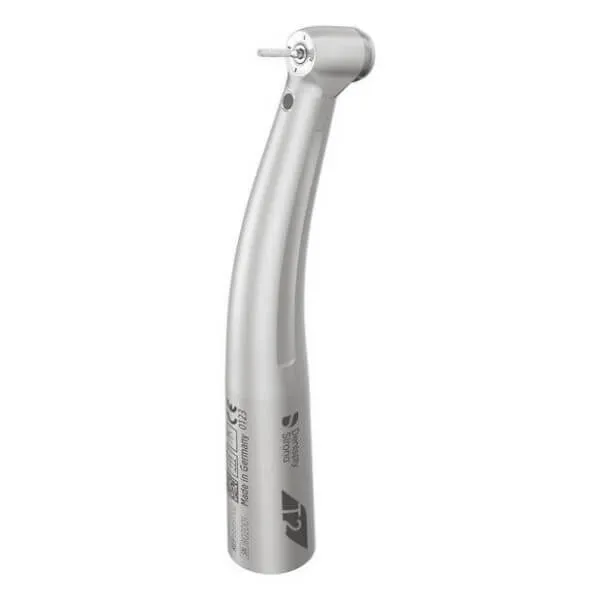
| T2 Boost (Sirona connection), Sirona T2 Boost S | Turbine | Fibre-optic light | Chairs with a Sirona coupling |
| T2 Mini S | Turbine, mini head | Fibre-optic light | Children, third molars, limited opening |
| T1 Control, T1 LED Control, T2 Control S | Turbine | Standard head on the T1 models; LED on the T1 LED Control | Everyday restorative work |
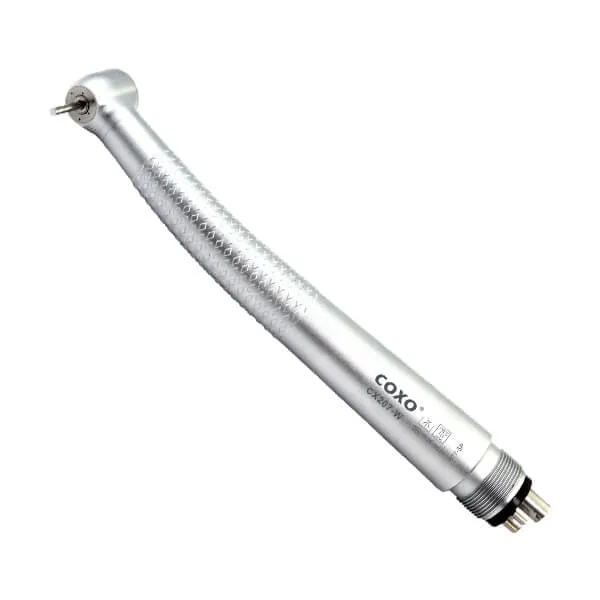
| High speed handpieces, 4 holes, 1 or 3 spray | Turbine, fixed connection | Single or triple spray, standard head | Midwest hose; spare handpieces |
| High speed handpiece, 45 degree, 4 holes | Turbine, 45-degree head | Built-in LED generator | Posterior access; check the exhaust design before surgical use |
| Sirona T2 Energo 1:5 L, Sirona T3 Energo 1:5, T3 Line E 200 (1:5) | Electric contra-angle, 1:5 | LED and 4×2 nozzle spray on the T2 Energo L (Dentsply Sirona) | Chairs with a micromotor |
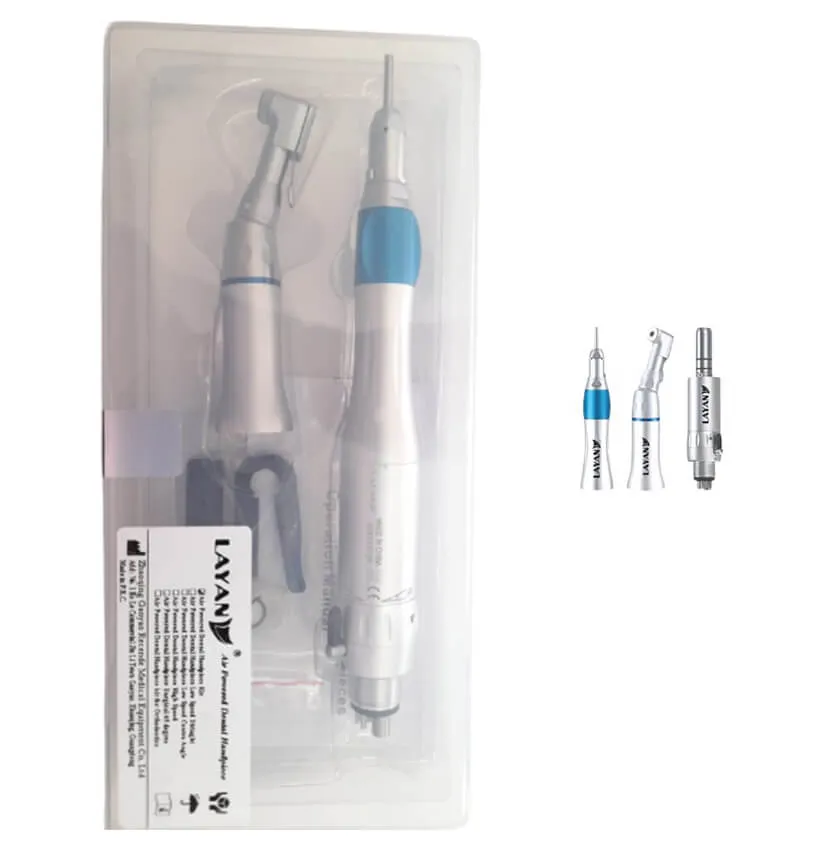
| T3 Line E40 and EH40 (1:1), T4 Line B40 and BH40, T2 Line AH 40L, kits | Low speed | 1:1 on the T3 Line models; one kit includes an air motor | Caries, finishing, polishing, acrylic |
| Lubricating machine, oil sprays, DAC Universal adapters | Care | Adapters fit DAC Universal, which cleans, lubricates and thermally disinfects | Daily reprocessing |
Match the handpiece to your chair's hose first, then choose the drive type and head size.