The problem: two motions, one decision that shapes every case
Every clinician who shapes canals with nickel-titanium files eventually asks: continuous rotation or reciprocation? The motion is not a free setting. It is part of the file's design, and it decides which motor you need, how you prepare the glide path and what each case costs. This guide explains how the motions work, what the evidence shows and where it is mixed, and how to choose by case and experience. The files we stock are rotary systems; several of our motors also offer a reciprocating mode.
Understand: rotation, reciprocation and the motions in between
Continuous rotation
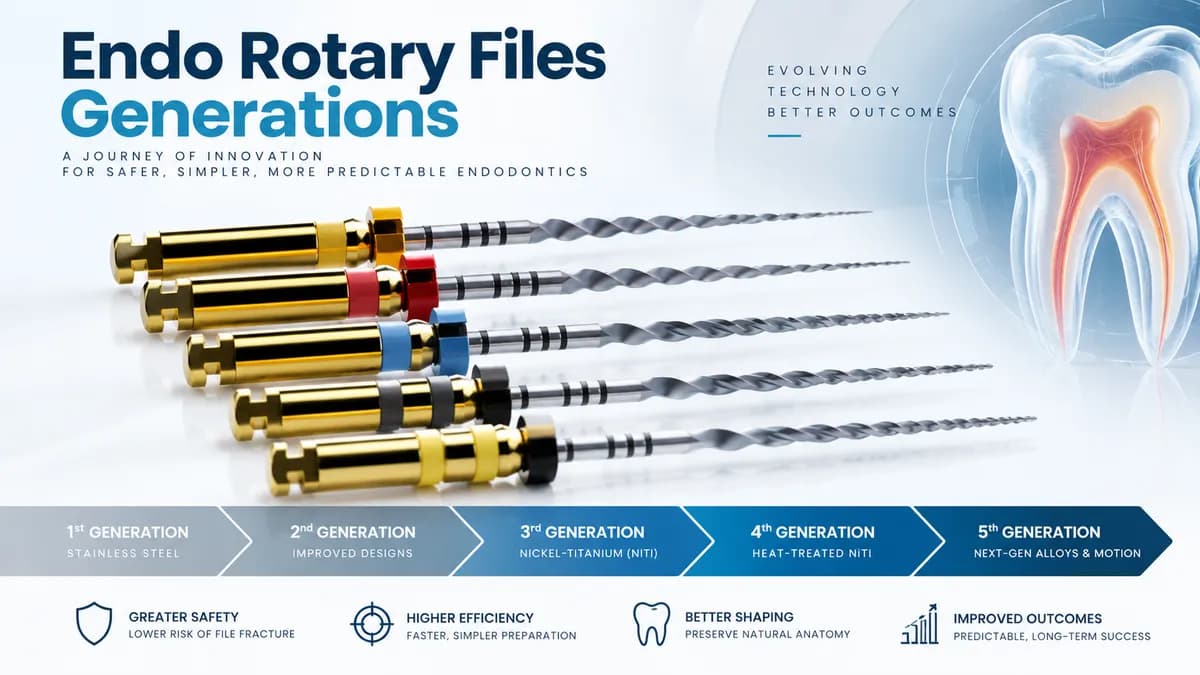
A rotary file turns clockwise through full circles at its maker's speed and torque, cutting dentine and carrying debris coronally. Every rotation in a curve adds to cyclic fatigue, and if the tip binds while the shaft keeps turning, torsional stress rises until the torque limit and auto-reverse step in. Sequences range from several shaping and finishing files to two or three.
Reciprocation
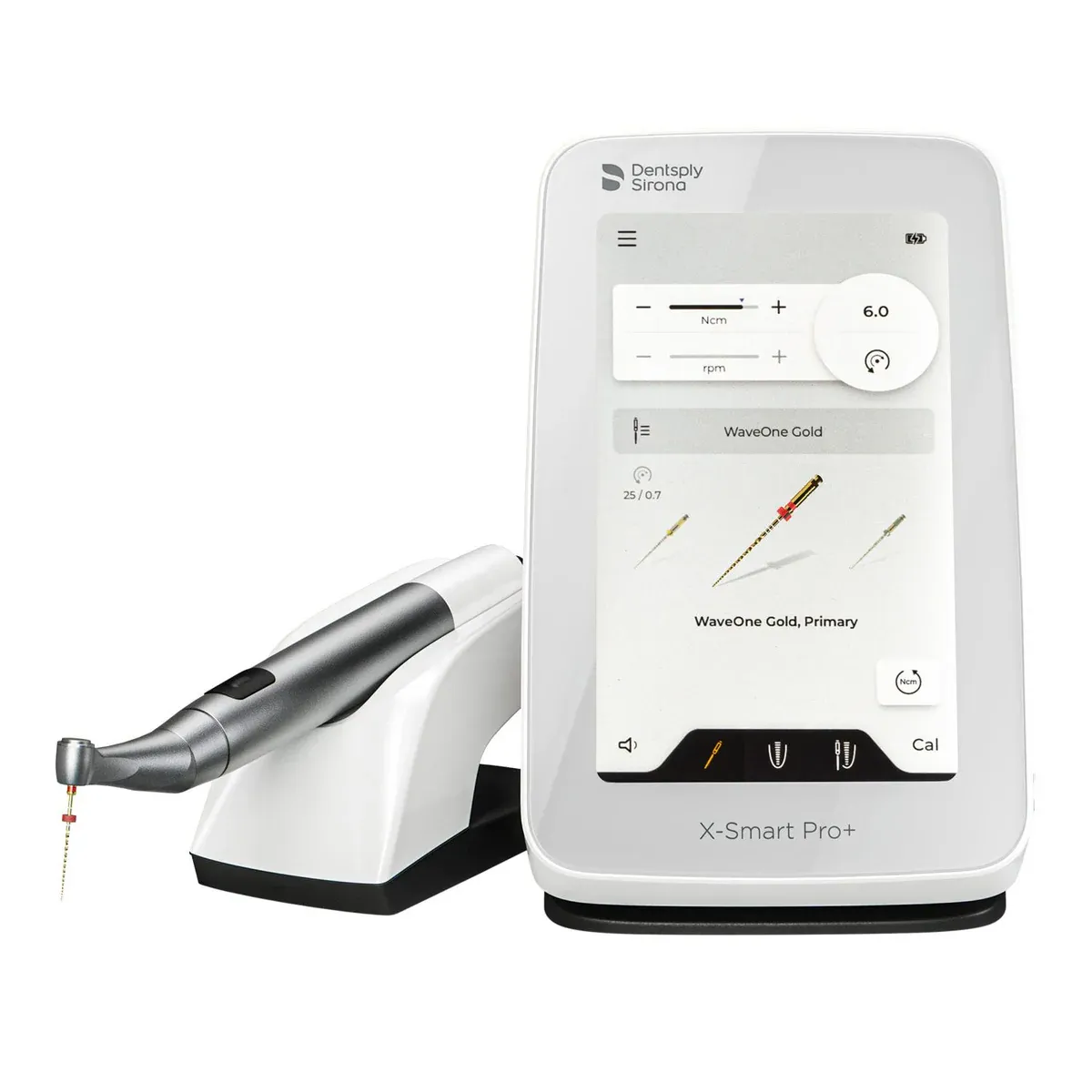
A reciprocating file turns further in its cutting direction than back, so it advances without turning far enough to lock, yet completes a full turn every few cycles. WaveOne Gold moves 150 degrees counterclockwise to cut and 30 degrees clockwise to disengage, three cycles make one rotation, and it runs on a motor pre-programmed for it.5 VDW states that the Reciproc angles are specific to its instrument design and motors.6 These systems use one file per canal, chosen by canal size.
Adaptive and torque-reverse motions
Kerr's adaptive motion rotates under light load and changes to reciprocation as the load rises, with its own TF Adaptive files. Torque-reverse modes, such as Morita's optimum torque reverse, rotate and reverse through a small angle only when a set torque is reached. The C-SMART-I PILOT we stock can reverse, stop or reciprocate at its torque limit. These modes are a safety net, not a substitute for the file maker's settings.
Fatigue, torsion and heat-treated NiTi
Reciprocation was developed to reduce both failure modes: fewer net rotations in the curve, and a file that releases before torsional load peaks. In a 2026 laboratory comparison in an artificial curved canal, reciprocating files generally lasted longer measured in time, but the difference narrowed, and in two test series reversed, when counted in full rotations; alloy and file dimensions mattered as much as the motion.3 Early comparisons also set reciprocation against conventional NiTi. Heat-treated controlled-memory, gold and blue files are more flexible and fatigue resistant, current reciprocating files are gold or blue treated too, and a file's alloy, taper and cross-section now often matter more than its motion.
Shaping, extrusion and pain: what the studies show
- Evidence. In curved mesiobuccal canals of maxillary molars, rotary (ProGlider, ProTaper Next) and reciprocating (WaveOne Gold Glider, WaveOne Gold Primary) sequences both stayed well centred on micro-CT; the reciprocating file removed more dentine at maximum curvature.4
- Evidence. Laboratory studies of apical debris extrusion conflict; one measured more debris with a reciprocating file than with adaptive motion, and more with adaptive motion than with rotation.2
- Evidence. Meta-analyses of pain after primary treatment reach opposite conclusions; in retreatment, most of five randomised trials found no significant difference.1
Glide path, files per case and cost
Clinical guidance for WaveOne Gold treats a loose size 10 K-file at working length as the minimum.5 VDW allows Reciproc without a separate glide path in many canals, requires one to ISO size 15 when the scouting hand file must be pre-bent or does not reach length, and designs the files for single use on no more than one molar.6 Rotary sequences follow a glide path to at least size 15 and use more files per case, so cost per case depends on the price per file, the files in your sequence and whether your motor already has the programme.
Options: the files and motors we stock
| Item | Motion | Notable features (manufacturer) | Fits |
|---|
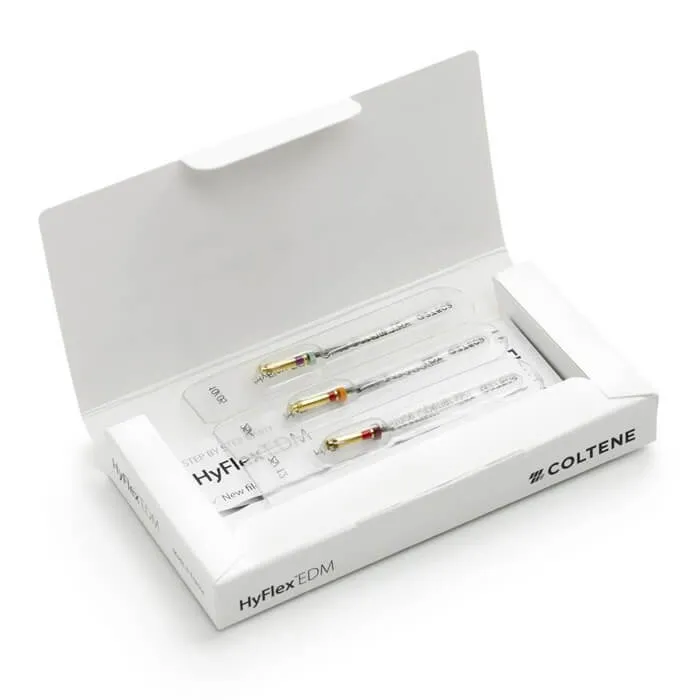
| Coltene HyFlex EDM Glidepath File 10/.05, 25 mm | Rotary | Dedicated glide-path file | After a size 10 K-file |
| Coltene HyFlex EDM OneFile 25/~, 25 mm | Rotary | Named for shaping with one file | Short rotary sequences |
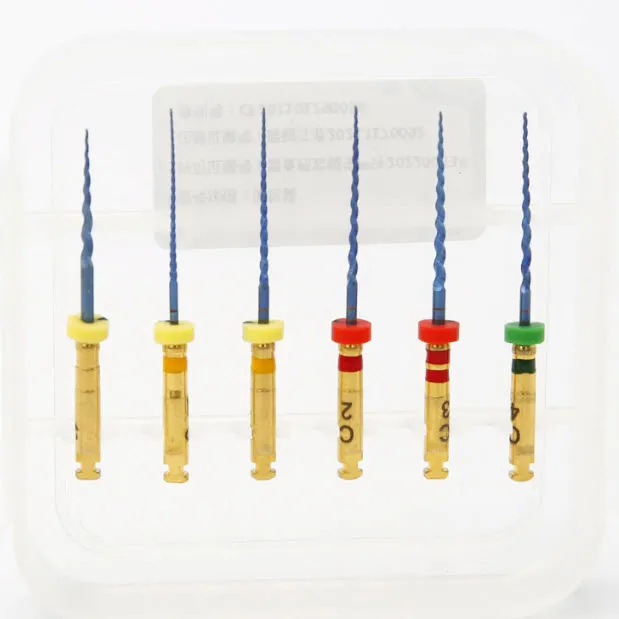
| IMD MPro Blue set (10, 15, 25, 35), 25 mm | Rotary | Blue NiTi, four sizes | Curved canals |
| Meta Biomed Aurum Blue assorted, 21 and 31 mm | Rotary | Controlled-memory files | Curved canals |
| Dentsply Sirona X-Smart Pro+ | Rotation and reciprocation | WaveOne Gold, Reciproc Blue, ProTaper Ultimate and TruNatomy presets; integrated apex locator | Reciprocating and rotary files |
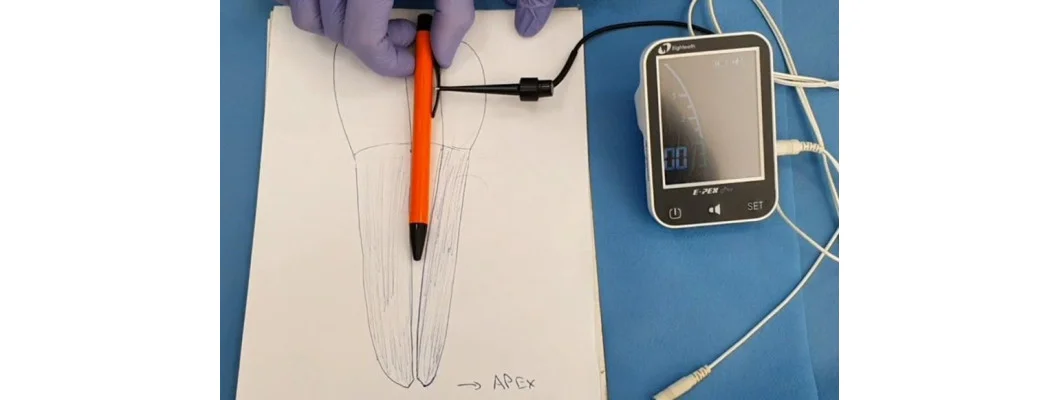
| COXO C-SMART-I PILOT | Rotation; reciprocation at the torque limit | Integrated apex locator; reverse, stop or reciprocate at the set torque | Measuring and shaping in one unit |
| Saeshin E-Cube | Rotation and reciprocation | Reciprocative function and portable handpiece (product name); auto-reverse | Portable use |
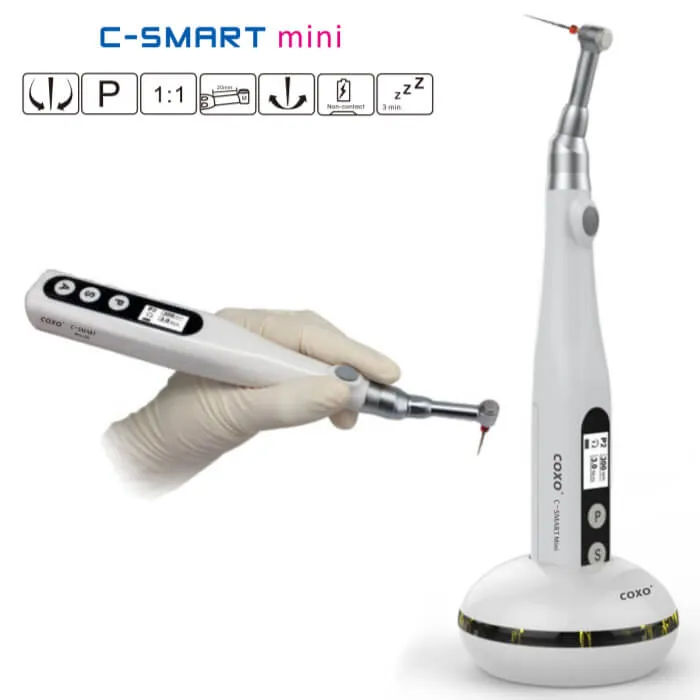
| COXO C-SMART Mini | Rotation and reciprocation | Cordless; reciprocating cutting function; no apex locator | A compact second motor |
We do not stock a dedicated reciprocating file system such as WaveOne Gold or Reciproc; to use one, pair it with a motor that carries its maker's programme.
Compare: continuous rotation against reciprocation
| Criterion | Continuous rotation | Reciprocation |
|---|
| Motion | Full clockwise rotation at the maker's speed and torque | Unequal cutting and release angles set by the maker, such as 150 and 30 degrees |
| Cyclic fatigue | Accumulates with every rotation in a curve | Longer in time in the laboratory; the gap narrows counted in rotations |
| Torsional load | Rises if the tip binds; torque limit and auto-reverse protect | The file releases on every reverse stroke |
| Centring and dentine removal | Well centred in curved molar canals | Well centred; more dentine removed at maximum curvature |
| Apical debris extrusion | Less in some laboratory comparisons | More in some laboratory comparisons; studies conflict |
| Postoperative pain | Meta-analyses conflict | Meta-analyses conflict; similar in retreatment |
| Glide path | As the maker directs, commonly to size 15 | Loose size 10 minimum for WaveOne Gold; size 15 for Reciproc if the scouting file needs pre-bending |
| Files per case | Usually several | Usually one per tooth |
| Motor | Any endo motor with speed and torque control | The maker's programme or its exact angles |
By case and experience
| Situation | Reasonable choice | Why |
|---|
| Straight or mildly curved canal | Either motion | Low load on the file |
| Severe or double curvature | Heat-treated, small-taper file after a glide path, in its approved motion | Alloy and dimensions affect fatigue as much as motion |
| Narrow or calcified canal | Glide path to size 15 before any shaping file | A scouting file that needs pre-bending calls for one in either motion |
| New to NiTi | Few files, on a motor that stores their settings | Fewer steps and settings to get wrong |
| Retreatment | Either motion, with retreatment files as needed | Pain outcomes similar in trials |
| Motor without reciprocation | Rotary files | A reciprocating file needs its programmed angles |
Choose continuous rotation if you already work with a rotary sequence and a torque-controlled motor, want a wide choice of sizes and tapers, or treat many curved canals suited to a small-taper heat-treated sequence. Choose reciprocation if you want one file per tooth, have a motor with the file maker's programme, and will keep to the glide path the system requires. Choose a motor with both motions if you have not decided: it keeps both options open.
Using either motion well
- File first, then settings. Set the motor to the file maker's programme: speed and torque for rotary files, published angles for reciprocating files. Never run a file in a motion its maker has not approved.
- Access and length. Isolate with a rubber dam, gain straight-line access and scout with a size 10 K-file to a working length confirmed with an apex locator and a radiograph.
- Glide path. If the scouting file must be pre-bent or will not reach length, enlarge to size 15 by hand or with a glide-path file before any shaping file.
- Light strokes. Use short in-and-out strokes without pressure; withdraw every few strokes to clean the flutes and recapitulate with a small hand file.
- Irrigate safely. Keep sodium hypochlorite in the canal, with the needle loose and short of working length, and never force the plunger: hypochlorite pushed past the apex causes severe pain, swelling and tissue damage.
- Stop, do not push. If the file does not advance, withdraw, irrigate and return to a smaller instrument; discard any file that shows unwinding or distortion under magnification.
- Discard and sterilise. Discard single-use files after the case and sterilise the contra-angle according to the motor maker's instructions.
Recommended products
Rotary files for the glide path and shaping:
Buying advice
If your motor has torque control and your rotary sequence works, there is no need to change motion: put the budget into a glide-path file and a heat-treated set for curved canals. If you want reciprocation, choose a motor that carries, or can be set exactly to, the file maker's programme, then buy that file system from its supplier, as we do not stock one. Compare the X-Smart Pro+, C-SMART-I PILOT and E-Cube on stored programmes, apex locator integration and portability.